Monday, April 30, 2012

Comfort Tip-High Velocity Ducted System

There are several homes out there in which running ductwork just may not be practical. Every year we see several of these types of homes with limited or no space at all for our ductwork, yet the builder, homeowner or architect expects us to perform a miracle and just keep that nasty looking metal ductwork out of sight and out of mind. I have even seen several sets of house plans in which the heating and cooling is not even considered in the plans, this is a sad problem since most homes are uncomfortable and one of the most common complaints that a homeowner has with their new home is the temperature problems. Some of the issues that we run into is that there is no space or place to run the large rectangle ducts or our customer may insist that there can be no ductwork below the floor joist or no soffits built to conceal our ductwork. When this happens we do a lot of head scratching and try to come up with a logical solution without jeopardizing the homeowners comfort.

One of the solutions that we have available is to install a High Velocity Ducted System. With this type of ducted system we actual install several small pipes in the home instead of the commonly seen large ductwork. This type of system works really well for homes that are already built and the homeowner wants to add air conditioning but has limited space. It also works really well when we look at a new construction home with a large open floor plan. The open floor plans are becoming more and more popular due to advances in trusses and joist designs. With the open floor plans there are little to no interior walls in which we can run our ducts so the High Velocity makes a lot of sense.

Check out our You Tube Video in which we installed a High Velocity System for more information, or just give me a call at 913-268-6700.

Thanks

James Gallet

Envirotech Heating and Cooling
913-268-6700


Tuesday, March 27, 2012

Energy Tip- How "Cool" Is Your Ductwork

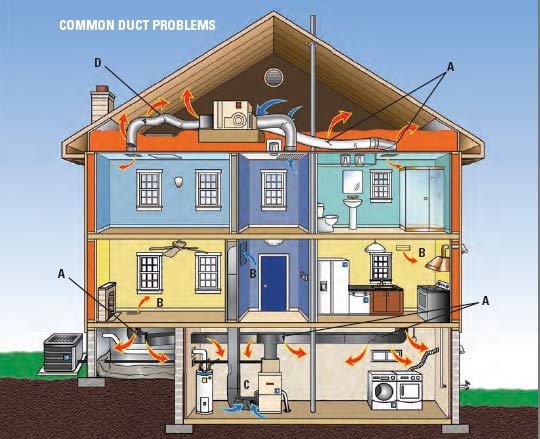
It is not "Cool" to have leaky ductwork in a home or office; however the ductwork is often an overlooked item even though it is a key component to your comfort system. Leaky ductwork in a heating and cooling system can waste hundreds of dollars every year and also cause a home or building to be uncomfortable. Your air distribution system is made up of two main pieces of ductwork or trunk line. One trunk "blows" the cool air in the summer and warm air in the winter to different rooms and areas, commonly called the supply duct. You also have another trunk that "sucks" air back to your furnace or fan coil to be reconditioned, commonly called the return duct. This cycle continues over and over again until the thermostat tells the system "I am good, you can stop running now".

Ducts naturally leak by the way they are constructed or installed, each connection point from one piece of duct to another is a potential source for air leakage because the ductwork will expand and shrink as the temperature of the air within the duct changes. Air can leak both in and out of your ductwork and this will cause your heating and cooling equipment to work harder and less efficient.

Your Comfort can be at stake if you have "leaky ducts" in your attic, crawl space or basement. Leaky return air ducts will allow unconditioned air to be returned back to the furnace or air handler instead of pulling air from the main living space. Leaky supply ductwork will not allow certain parts of a home to get the proper airflow; therefore rooms will be too hot or too cold.

Another key issue is Higher Utility Bills; think about it, if you are dumping cold air in the summer into your attic instead of where it needs to be then the air conditioner will have to run longer in order to get the home comfortable. This longer run cycles will cost you more in utilities. Another scenario could be if the return air duct is pulling warm (120 degree) air from an attic or crawl space during the summer instead of the air within the home (72 degrees). This 120 degree air is now mixing with the 72 degree return air and causing the air conditioner to work harder in order to get cold air coming out of your vents.

Leaky ductwork can also cause a Dusty Home, a typical home contains around 180 linear feet of ductwork and your ducts can accumulate more than 40lbs of household dust each year. Leaky ductwork will spread this dusty air throughout the home, while sealed ducts deliver cleaner, filtered air.

So what can you do? Well one thing that you can do is to have your ductwork sealed. This can be done by using the metal duct tape (not regular duct tape) or a mastic duct caulk; both can be found at most hardware stores. We also offer duct sealing as one of our services, so if you don't want to mess with it give us a call.

Please give us a call if you have any questions or comments about leaky ductwork anytime. You can also access a free brouchure on duct leakage and what to do by clicking in the following link: http://www.energystar.gov/ia/products/heat_cool/ducts/DuctSealingBrochure04.pdf?9bdc-34b6

James Gallet
913-268-6700
http://www.envirotechks.com/

Tuesday, February 14, 2012

Energy Tip-Air Filtration

Typically, during the winter months, we spend a lot more time indoors than we do outdoors. This is also when people tend to be sick more often, maybe it is the lack of sunlight or maybe it is the air within our homes. Who knows for sure, but we do know that the air inside our homes can be 5-Times more harmful to breathe than the air outside! Wow!

Choosing a good air filtration system is not only beneficial for you and your families health but it is also important in the protection of your homes heating and cooling system. There are several different types of air filters and systems on the market today for your home and business. Filtration systems are generally marketed towards protecting your personal health but like I said they also are important in protecting the well being of your heating and cooling system. So which one is right for you?

Well first of all lets discuss how they rate air filters. The common terminology used today to rate the effectiveness of air filters is their Minimum Efficiency Reporting Value, or "MERV" for short. The higher the MERV rating the more effective the air filter is at blocking and capturing indoor air particulates such as dust, dander, skin flakes, etc...

We recommend that you have at least a MERV 8 filter in your system. The Ultravation Systems that we install commonly is rated at a MERV 10. The 5" thick pleated filter needs to be replaced every six months and there are no mechanical parts to this system. Most filters that are sold at the hardware store for $3-$7 are no where near a MERV 8 and the cheaper filters that you buy at the hardware stores are rated somewhere in the MERV 1-2 range. There are a few 1" thick pleated filters on the market that are rated at a MERV 5, however you need to read between the lines. Some of the filter companies rate their filters after they are in use and not when they are brand new. So what this means is as the filter gets dirty its rating will increase.

So what do you do if you or someone in your family has severe allergies and the MERV 10 system just isn't good enough? One bit of advice is to have an Ultraviolet Light installed in your homes duct work. We can install a two bulb system that works very well. There is one UV light installed in the supply duct, just above your furnace that will kill any airborne allergen before they make their way to your vents and another installed in the return air duct above the air filter system, the unit in the return duct will kill anything before the filter and then the filter captures the airborne allergens.

Some people will require even a better system than a UV Light and Media Filter system. In that case we recommend a bypass type air filtration unit. This will be an externally mounted filtration system that will bypass air in your duct work and return the filtered air to the system. The reason that we cannot go with just a higher MERV rated filter system is due to airflow requirements once you get above a MERV 16 the airflow is really restrictive and can actually do damage to your homes heating system. The bypass unit still allows proper airflow to the system while allowing an additional amount of filtration.

For more information on the Ultravation products please visit http://www.envirotechks.com/indoor-air-quality if you have questions on the bypass models or anything else, then please feel free to give me a call.

Thanks

James Gallet

Friday, December 9, 2011

Energy Tip- Are Your Pigeons Warm On Your Roof?

Earlier this week we had a nice brisk morning and I was running a little early to my 8am sales call. I decided to drive around the neighborhood I was in to check out some of the homes roofs near my appointment. Why in the world would I want to look at a roof at 7:30am? Well, believe it or not you can tell a lot about the insulation of an attic, ventilation of an attic, air leaks and possibly discover some other issues within a home by checking out a roofs frost patterns.

The frost pattern or frost on a roof is different than the snow on a roof, so this little bit of advice wont do you much good with the snow on a roof. You see the air inside your attic is considered outside of your building envelope, or outside of your home, therefore the temperature in your attic should be at or close to the same temperature as the outdoor air temperature. This is only true, however, if your attic is properly insulated, vented and sealed off from your living space below. So in the early morning hours before the sun is out you should see no difference in the frost pattern across the roof. Once the sun hits the roof it is hard to see the trouble area since the frost will melt quickly.

There was a few homes in this neighborhood with some major issues. The biggest issue that I found was with the two story home to the right in my photo. As you can see, there are two large sections of frost on the shingles, but no frost at all towards the top of the roof line. This home has the same layout, or design, as the other two homes in the photo, so in reality they should all have a fully frosted roof. I am guessing that on the upper home, with the issues, the two sections with frost have rolled insulation in an attic or ceiling space and the bare spots are probably blown in insulation above a ceiling. This troubled home probably has several air leaks from the second floor into the attic such as can lights, bathroom exhaust, vent pipes and may have leaky ductwork in the attic as well. Whatever the case may be they are spending alot each year to not only heat their home but also to heat their roof.  

So the next time you look out your window, before the sun comes out and see frost on the ground, slip on your warm slippers and check out your roof to see what you may discover. You may find that just doing a little insulating or sealing can help save you some big bucks and keep your home more comfortable year round. Hey, don't worry about the pigeons, they can go to your neighbors roof to stay warm.

Thanks and have a great Holiday Season!

James Gallet


Monday, November 14, 2011

Energy Tip-No To Plastic/Solar Water Heating

So where in the world did October go? Well for me October was filled with lots of running around trying to get caught up or not get any further behind, one work trip to Lubbock, TX and then a nice week long vacation with my lovely bride to Maui.

I could go on and on about how beautiful Maui was, from the scenic hikes we took, to the snorkeling and so on, but instead I am going to tell you about some other bits of information about the island. I found it fascinating that the entire Island had no plastic bags on it! That meant when we went to the supermarket for some snacks, bought souvenirs or whatever the case you were not carrying out your stuff in plastic bags.

We visited a Walmart (imagine that, they had a Walmart there) and at the check outs they had the bag carousels but no plastic bags. When we bought items at small shops the items were put in paper bags and we were not given a paper or plastic option. It seems that the Island of Maui in January of this year took away all of their plastic bags so you either bring in your own recyclable bags or you just tote your shopping cart out to your car and unload the items one by one into the floor. I thought this was a pretty neat idea and wish the rest of the US would adapt this.


Another neat thing was that our hotel room had no liner in the trash cans and the room even had a separate trash container for recyclables. There were recycle containers located beside most trash containers in almost every public place and you could just tell that they people just had recycling and reusing as a way of life. 
 
So whats this solar stuff in my title? Well another thing that I found to be of interest was that solar water heating was huge over there. I saw more ads and advertising about solar products (mainly water heating) than I did for any other service. It was weird driving around and seeing a water heaters sitting outside of the homes but it was really cool to see all of the solar panels installed that were preheating the water that fed these water heaters.

Coincidentally enough the week that I returned from Maui I was already registered to attend a solar water heating class so I was anxious to learn more about the design and installation of these products. I learned that solar water heating is quite a bit more expensive to install than conventional and hybrid water heaters so it may not fit your budget, even with the big tax credits available. There is however a market for solar water heating, so it could be something to investigate if you are looking to save on fuel and plan on staying in your home for several years. The way that a solar water system typically will work is that the solar panels (generally located on a roof) will heat the water as it passes through the tubes. This preheated water then travels to a storage tank that can be a standard water heater or tankless type water heater and the hot water that you use in the home pulls from the storage device. If you need more hot water than the solar panels can provide for you then the storage tank or backup source will kick in and heat the water for you.

I can see several advantages and disadvantages in using solar to heat the water in a home. The main
advantage is that the sun energy is free, so the monthly energy cost will be lowered in a home. The main disadvantages are the initial cost is high and when most people use the biggest bulk of hot water in a home (morning and night) the sun is not out so you will be likely pulling from your backup source.

So if your in the market for a new water heater here is yet another option for you to consider, but I urge you to do some homework first and find a company that has installed several solar systems that can give you solid referrals if you go the solar route.

PS lets get the rest of the world on board with Maui and do away with these plastic bags, if you want I will send you a free reusable grocery bag to get this fad started. Just shoot me an email at jamesg@envirotechks.com with your mailing address and I will send one to you.

Until next month, thanks for reading have a great week and a Happy Thanksgiving!

James Gallet

Friday, September 23, 2011

Energy Tip- "Give Your Water Heater a Blanket"

I was sitting in the kitchen this morning when my 8yr old came strolling in with a big blanket wrapped around her (I remember those days when I would eat breakfast with a warm blanket around me). For some reason this got me thinking of water heaters on my way into work. I am a big believer in the tankless or hybrid water heaters, however some homes and businesses are better off with a conventional tanked water heater as opposed to the tankless or hybrid models. So if your water heater is one that is a conventional tanked model then you need to give that "girl" a blanket.

Here in the Kansas City area most of our water heaters sit in a basement or garage. The water heaters are constantly losing heat to the air around them. Think of your water heater as a biog thermos with a built in heater, as the "big thermos" losses heat to the air around it the built in heater automatically heats it back up. This is why you always have hot water ready to go at your faucets. This lose heat then reheat cycle is repeated over and over again through the course of the water heaters life. Unfortunately it is even repeated when we are not using the water heater like over night and when we are away from our homes.

One big thing that you can do is to wrap your water heater with a insulation blanket specifically designed for water heaters. You can purchase them at nearly any hardware store and they cost around $25. They are easy to install and this $25 investment will end up getting recouped in utility savings over just a couple of months.

Here are a few other things that you can do to improve your water heaters efficiency and help cut back on your energy usage:

1. Turn down the heat setting a bit, do you really need it set as hot as you have it now?
2. Insulate your hot water pipes in addition to your heater itself, again you can get pipe insulation at most hardware stores.
3. Fix any leaky faucets, this one little drip can cause not only high water bills but also high gas or electric bills if it is on the hot water side.
4. Insulate the room the heater is in, most of the time the water heaters are located in a cold area or basement room possibly even a walk out basement.
5. Turn it off or use the vacation setting when you are out of town.

I hope that you found something in this article helpful. Please feel free to call or email me any suggestions, comments or questions. 

Thanks

James L. Gallet
Envirotech

Friday, August 19, 2011

Energy Tip- Light The Natural Way

In the past I have written about using CFL or LED lighting for your home. Well there is another solution to lighting your home and guess what, its free! Before the widespread use of electric lighting architecs and builders constructed buildings to take advantage of natural light. Well this way of thinking and building has gone by the wayside and in its place we want homes that are pretty and people seem to not worry so much about effeciency and lighting (at least until we open our utility bills anyway).

What can natural daylight do for you and your home? Natural lighting will not cost you anything in utility bills for one, but sunlight also help aid in relaxation and happiness and helps reduce seasonal affective disorder (SAD), also known as the winter blues. Natural daylight has also been proven to improve students test scores, double retail sales in stores, and boost factory workers productivity.

What will it do for our planet? If we all reduced our electric lighting in our homes by 25%, natural daylight could save enough energy to power 17 million homes a year. WOW!!!! 

Who do you call? Here in Kansas City we have one of the best daylighters in the business. Sam Kane with Solar Solutions can install a tubular skylight and bring in the natural daylight for you and your family. Sam and his crew have great knowledge and look at each home on an individual basis to determine where natural lighting would best be served. They can install one tube if you would like and build onto it from there. To get in contact with Sam visit their website at http://daylightkc.com/. They also have some other great products available.

Check out the two photos below of a before and after shot that Sam and his gang took on one of there jobs. Please feel free to pass this along to others and let me know if you have any energy or green tips to pass my way.

Thanks

James Gallet


Before Natural Daylight


After Natural Daylight
 

Thursday, July 7, 2011

Comfort Tip- Mini Split A/C & Heat Pumps

What is a Mini Split? Well if you have ever traveled to Europe or Asia (I have not but have had a good customer and friend of mine inform me of this) you have probably had your hotel room or living quarters heating and cooled with this type of system. I know that most Asian areas have very limited amounts of space, therefore this system is perfect for tight areas with little or no space outside or on the ground. If you are not into traveling abroad, here in the US the mini split systems are catching on due to their high energy efficiency and also for space conditioning of hard to heat rooms, rooms with no access to duct work, room additions, attics and spot heating and cooling.

Fujitsu Outdoor Heat pump Unit
Did you know that as much as half of the energy used in our homes and offices are for heating and cooling purposes? Out of that we lose up to 30% of the efficiency in a standard heating and cooling system through leaky duct work, improperly sized or improperly installed equipment. The top of the line air conditioning units today being installed are rated at 16-18SEER, I like to compare SEER (or Seasonal Energy Efficiency Rating) to miles per gallon on a car. The higher the SEER the better your MPG or utility usage is. The Mini-Split systems can achieve upwards of 26 SEER.....WOW!


The most common type of Mini Split that we install are the wall hung heat pump models. There is no duct work for this system and it will heat as well as cool. We have grown to love the quietness, ease of installation and operation of the Fujitsu brand systems. Some of the jobs in which we have installed the Mini Split systems are room additions, sun rooms (formerly a screened in porch), upstairs master suites, computer server rooms, finished basements with no duct work access, master bedroom additions and office spaces.

If you would like to see a video of one of our installs please visit the Envirotech Youtube page. I will be posting a newer installation in the coming months of a job we are doing now that is under construction. We are installing two outdoor units with five indoor units, so what that means is there are two heat pumps outside and a total of five indoor spaces with their own independent temperature controls. You can also view some photo's of the installs on the Envirotech Facebook page.

Please call me if you have any questions, comments or energy savings tips.

Thanks

James Gallet

Friday, May 27, 2011

Energy Tip-"Seal Your Ducts"

Right now we (Envirotech) are in the middle of our air conditioning clean and tune season. We are in several homes and businesses each day getting their systems ready for the summer heat, if it ever shows up. One item that we look at as part of your comfort system clean and tune is your ductwork. The ductwork can be overlooked by many as I know that homeowners pay no attention to it, in fact they would probably prefer not to have it at all. The ductwork serves a crucial role in delivering the proper amount of cool air in the summer and the warm air to our living spaces in the winter. When new ductwork is installed there are certain items that need look at to determine sizing, location and length. Unfortunately most ductwork installed is not sealed so this is something that has to be done after it is already hung.

This is Really Bad Ductwork!
A typical home contains about 180 linear feet of duct work. Nearly 30% of a home's conditioned air leaks out of these ducts, wasting energy in the process. Sealing the ducts will save you a significant amount of energy and money and also improves the indoor air quality in a home. Ducts accumulate more than 40lbs of household dust each year. Leaky ducts spread that dusty air throughout the home, while sealed ducts deliver cleaner and better air.

Your home might have leaky or bad ductwork if you experience high utility bills, if you have stuffy rooms that never seem to be comfortable, if you have rooms in your home that are difficult to heat and cool or if you experience alot of dust problems. If you look at your homes ductwork and see dirt streaks or lines at a seam or joint, this is a leak.

If you have leaks in your ductwork you can seal them yourself using a mastic seal or metal tape. The old grey duct tape wont due the trick, it tends to dry up over a few years and peel off. We can also provide this service for you if you would like. If your ductwork is located in an attic or crawlspace, it not only needs to be sealed (so you are not heating your attic in the winter and cooling it in the summer) but it also needs to be insulated. In our climate if your ductwork is located in a basement or within the conditioned space it can typically just be sealed and not insulated.

If you have questions on this please give me a call and I will happily answer them.

Thanks and have a great day!

James Gallet

Monday, April 11, 2011

Green Tip "Toilet Water"

This weekend we got the opportunity to enjoy some fantastic weather, it was a reminder that spring is almost here. I enjoy this time of year when everything is blooming, the sun shines into the evening, grass turns from brown to green and the kids get to burn off their energy outside.

One thing that I do not look forward to about spring and summer, at our home, is the higher demand for water. This not only causes our water bills to go up, it also makes me feel a bit guilty of the waste that seems to take place at times. The increase in water use is due to watering flowers, watering areas of the lawn, the kids 4H project animals and so on.

Last spring I installed a rain barrel and this really helped cut down on some of our water use. But the rain
barrel basically got shut down over the winter in fear of it freezing and causing downspout freeze issues. So during the winter months the rain barrel was no help to me and my water consumption efforts.

I recently ran across a few articles on what you can do to save or conserve water inside your home and found one that talked about toilets. Did you know that most toilets in the US will use over 3.5 gallons of water per flush? There are however some low flow toilets in some of our homes however they still use almost 2 gallons per flush. On average toilets account for 26% of your homes water usage, WOW! 

So what can you do to help? Well one thing you could do is install a dual flush toilet. A dual flush toilet has two flush buttons, you push the #1 button if you go #1, which uses very little water, or if you go #2 then press button #2 which uses more water (for obvious reasons). This option would require you to replace your current toilet.

Another option is to adjust your tanks fill level by either adjusting the float inside your tank or using what I am recommending which is an empty one gallon milk container or two liter pop bottle. What you do here is fill the empty container with a few rocks or sand and then fill it the rest of the way with water (preferably water from your rain barrel). You then take the tank lid off of your toilet's tank (the tank is the upper part of the toilet where your flush handle is located) and place the container in the tank. Make sure that you place the container as far away from the valve or any moving parts as you can. You will need to flush the toilet to get the water to run out of it in order to get the container in without making a big wet mess. The container should sit up by itself and should not interfer with any of the moving parts inside the tank. After you verify that it is in a good upright place, put the lid back on. You now saved yourself almost a gallon of water per flush. Add that up and in a weeks time and that could be several hundreds of gallons saved!

The photo above shows what a one gallon milk jug looks like inside one of our toilets at our office. Just a quick note is to make sure your container fits into the tank before you place it in there. One of our toilets at the office would not allow a one gallon milk jug to fit without interfering with the float assembly so I had to use a two liter pop container. 

Please share this with others and share any of your "Green Tips" or ideas with me.

James 

Friday, March 11, 2011

Cool New Management Device- Ecobee T-Stat

Here is a question for the ladies reading this: Have you ever left the house and wondered if you left your curling irons plugged in, the clothes iron plugged in or the stove still on? More than likely you answered yes to all of the above. In the past, I know that my wife has done this, heck we have even pulled back into the driveway a time or two so she can go check these items.

Today, I cant help you with the curling iron, iron or stove issue, but what I can help you with is the other question that people ask themselves when they either go out of town or just leave for the day. What is the thermostat set at?

I know a lot of people own setback thermostats that change the temperature in their homes at certain times of the day, but lets face it our schedules are constantly changing. I encourage you to use this setback feature on your thermostat, if you have one that allows this, and you will save money on your utility bills. In reality most of the setback thermostats are set to HOLD, which means it is just set at a certain temperature and left there. So today I want to introduce you to an even cooler, more up to date way to control your homes temperature from anywhere in the country.

I recently installed an Ecobee thermostat at my home as a way of trying it before we offer them to our customers. We love it! The Ecobee smart thermostat is by far one of the coolest new thermostats I have seen. This thermostat is Internet based and can be controlled remotely from anywhere you have Internet access. It also works with you iPhone or Android using the Ecobee App. I have been meaning to write about this new thermostat for a while and we have been testing ours so I could give you some great feedback and answer questions if you had any. Well my buddy, Daniel Sinclair down in Lubbock, Texas beat me to it. He blogged about this last week so now I am sure I will have to hear from him about me being a follower, instead of the leader (just kidding Dan).


The Ecobee thermostat is a WIFI enabled thermostat that has tons of features on it. You can operate this thermostat on your phone just like when you are at home and there are no additional monthly fees for this service! The photo above is my lovely bride controlling our home thermostat from here I-Phone. Pretty Cool, Right? Also you can setup a program for your home comfort system from any computer on the Ecobee website. Another really neat feature about this thermostat is that you can look at reports that show everything you would ever want to know about your home comfort system and thermostat. You can see run times, temperature fluctuations, humidity levels, and be alerted (by email) when something is wrong or needs attention.

One of the coolest things that I personally like is the weather button on the thermostat. I can walk up to my thermostat and see what the current weather condition is outside or I can push the weather button and get a 7-day extended forecast. So if I miss the news and don't see the weather report I just walk a few feet and push a button and there it is.

For the commercial customers, if you own several different businesses or one business, you can access this thermostat at any time! You can set temperature limits and even lock out the thermostat (passwords can be enabled) if you want. This can help you save money with your energy bills and know that you still have some control over what happens at your business.

This thermostat has so much more to offer with the phone applications, web portal, and reporting.

If you have any questions about this Ecobee thermostat you can either visit their website or give me a call.

You can also view Daniels blog site for more information. 

Make it a great day!

James Gallet

Monday, January 17, 2011

Energy Tip-Window Coverings

Do you ever get drug into the middle of an arguement or discussion between two friends? Well last week I got drug right into the middle of a discussion between some friends my family.

They were discussing if they should leave their blinds open in the winter to let some sunlight (heat) in or closed to keep the cold out. That is a really good question and if you do some research you will get different answers I am sure. Well I shared with them my "green" opinion, which was to open their South facing blinds in the day time and close them at night.

Well this ended up not being my buddies opinion, but rather that of his cute wife (so another win for the girls). I hated to take a side in this discussion and hope that just because my advice was not the one my buddy wanted to hear he wont write me off as a friend (haha).

There are several different window coverings out there and alot of the newer blinds and drapes actually seal off pretty tight to reduce drafts. The heat that you will gain through the glass during a sunny day will offset any heat that you may lose through the glass or window from the blinds being open. Of course if you have bad windows or leaky window frames then you may want to purchase a few tubes of silicone or caulk to cut down on the drafts around the window seals or even have the window replaced.

So my suggestions are:

1. Make sure your windows are not excessively leaky, if they are leaky you can do wonders with a couple tubes of caulk or call me and I will get you the name of a company that we refer for window replacements.

2. On Sunny winter days open the south facing blinds and use that big ball of energy in the sky for some free heat. This also gives you free room lighting and will lower the need for lights to be on in those rooms.

3. Close your blinds at night to add some extra insulation value to your windows.

If you have any green ideas or tips please share them with me.

Thanks

James

Thursday, December 16, 2010

Green Tip-Electric Cars Are They Really Coming?

One of my favorite commercials on TV right now is the latest one that Nissan has rolled out. In this commercial it shows a polar bear (Aggie is the actual bears name in the video) sitting on a melting ice berg. Aggie then swims to shore, walks through town and goes up to a guy getting out of his new Nissan Leaf, an all electric car Nissan is manufacturing, and gives him a big hug. This commercial in my opinion is creative and also makes me think about My global footprint. The commercial also seems more realistic since we recently witnessed one of the largest oil spills or "oil gushes" in history. The images of the wildlife, beaches and businesses that suffered from the "oil gush" was horrible.

Well I do not know if electric cars are going to take over and replace the gasoline vehicles we drive today, but I do know that there is a lot of talk going on and Nissan is not the only player in the game. Electric cars are not a new idea by any means, in fact back in the early 90's California had a program going with GM and there were thousands of these cars on the roads. Where did they go? Well I am not sure but there is a real interesting documentary called "Who Killed the Electric Car". I have not found or seen any videos that represent any other opinions on what happened to the electric car program in California, so until something surfaces you will just have to draw your own opinion. If you don't want to watch the full 2hr version of the documentary, you can view a short portion of the video by clicking on this link: Who Killed The Electric Car, Youtube 

The negatives about the Electric cars, from what I have found has been the batteries and ability to charge the vehicles. A few weeks ago I attended a networking breakfast and ran into a guy who is with Lily Pad EV. Lily Pad is a distributor of Coulomb Electric Vehicle Charging Stations, they sale and install the charging systems that actually keep the electric cars going. Lily Pad has charging units that range in the ability to be mounted in your homes garage for a single vehicle, charging units that can be mounted at an office for multiple vehicles and also charging units that would have the ability to do a quick charge, just like we fill up our cars today. You can view their products on their website at LilyPad EV

So are electric cars really coming? Only time will tell, but for the sake of Aggie I sure hope they do.

If you have any energy or green tips you would like to share, please send them my way.

Thanks and have a great day,

James Gallet
Envirotech

Monday, October 18, 2010

Energy Tip- Clean Your Furnace

Did you know that your furnace and air conditioner accounts for up to 60% of your home's utility bills? Did you also know that if you equipment is dirty or slightly running a little rough it could be costing you additional money each month? Each heating season you need to have your furnace professionally cleaned by a licensed service company.

There are a few things that you as a homeowner can do to help with your system such as replacing you air filter at least every other month, visually inspecting the burner flame (it should be blue in color, yellow is bad) and also keeping items clear from the front and sides of the furnace. However a professional company will dis-assemble the furnace and clean it properly, inspect the heat exchanger, inspect the flue piping and fittings, test the ignition, ensure proper burning, inspect the electrical components, test all the equipment safeties and perform a carbon monoxide test.

I would say that utility savings is probably the second best reason to have your furnace cleaned and inspected every year, the first reason is safety. Each year over 500 people die from carbon monoxide poisoning, many which could have been prevented with a furnace clean and tune.

OK so most of my post are related to saving you money, conserving energy and helping the planet. Well this one is no different it is aimed at doing the same thing. However, in addition to conserving energy this post is directly related to my business as well (Envirotech Heating & Cooling), so if you decide to follow through with my advice on this post, just give us a call at 913-268-6700 or visit our website at www.envirotechks.com to schedule an appointment.

Here are some additional Safety Tips for you from the US Department of Fire Safety. 

• Never discard hot ashes inside or near the home. Place them in a metal container outside and well away from the house.

• Never use a range or an oven as a supplemental heating device. Not only is it a safety hazard, it can be a source of potentially toxic fumes.

• If you use an electric heater, be sure not to overload the circuit. Only use extension cords which have the necessary rating to carry the amp load. TIP: Choose an extension cord the same size or larger than the appliance electrical cord.

•Aviod using electrical space heaters in bathrooms, or other areas where they may come in contact with water.

•Frozen water pipes? Never try to thaw them with a blow torch or other open flame, (otherwise the pipe could conduct the heat and ignite the wall structure inside the wall space). Use hot water or a UL labeled device such as a hand held dryer for thawing.

•If windows are used as emergency exits in your home, practice using them in the event fire should strike. Be sure that all the windows open easily. Home escape ladders are recommended.

•If there is a fire hydrant near your home you can assist the fire department by keeping the hydrant clear of snow so in the event it is needed, it can be located.

FINALLY . . .

•Be sure every level of your home has a working smoke alarm, and be sure to check and clean it on a monthly basis.

•Plan and practice a home escape plan with your family.

•Contact your local fire department for advice if you have a question on Home Fire Safety.

LET'S ALL HAVE A SAFE AND HEALTHY WINTER.....James Gallet

Monday, September 13, 2010

Energy Tip- Recessed Can Lights

Have you ever been to a seminar or meeting and when you leave you are so pumped up to make a change in your life that you feel like someone has just refueled your engine?

Well I got my energy tank re-fueled last week when I got a visit from my good friend Dave Robinson. I have known Dave for several years now and see him as one of the sharpest guys I know.  He is definitely one of the most energy conscious guys I know, and has been a real cheerleader for me in my energy audit ventures. Dave sits on the California Energy Commission and is a local and national speaker in the "Green World". His latest business is purchasing old homes and making them energy efficient and them reselling them. His mission is to "Save the Planet, One Foreclosure at a Time". You can check his work out and follow his travels at www.greenearthequities.com

Dave and I were up into the late hours looking at energy blogs, websites and sharing our recent energy or lack of energy experiences. I got some great ideas and was put in contact with some items and tools that I have not been able to get my hands on in the past.

One item in particular is a recessed or can light cover. In the past, when performing energy audits I have suggested replacing old leaky can lights with airtight versions. Well I now have found a source for an airtight light cap that is placed over your recessed light in your attic. You can then insulate around and over the top of the light and eliminate the huge air leak that you get with the old style recessed lights. I have ordered a dozen of these covers and will be happy to share my experience with the product after they are installed next week.


Just a side note, when I perform an energy audit the biggest source of air leaks in a home are usually attic fans, can lights, fireplaces, cracks around doors and exterior wall electrical boxes. 

Thanks for the help Dave, and for putting up with the three crazy Gallet kids. We all look forward to breaking bread with you again soon.

Tuesday, August 24, 2010

Green Tip- School Lunches

So the kids are now back in school and the summer is winding down. That doesn't mean that our lives get any less hectic though, it just means we have a new set of task and obstacles ahead of us. I don't know why but the other day I was thinking about school lunches. I try to visit the kids at school and eat with them a few times a year and I recall alot of waste and trash that gets accumulated during lunch time. I am not just talking about food waste, which there is alot of, but also the trash that cold lunch or lunch from home can accumulate.

So I have came up with a few tips on how you can help reduce waste when you are packing your kids school lunch. So here are my recommended ideas: Eliminate plastic bags, plastic utensils, disposable containers, paper napkins and those brown bags. Instead use a reusable lunchbox, pack your kids a thermos or some type of reusable drink container, and try to send cloth napkins and silverware (I know they may no make it back home and this idea is pushing it).

From what I have seen and researched, by using reusable items you could save as much as $250 per year and over 80lbs in waste. WOW!!!!

Let me know if you have any "Green" ideas that you would like to share, I would love to post them on the blog.

James Gallet

Wednesday, July 28, 2010

Energy Tip-Ceiling Fans

Do you know which direction your ceiling fan should turn in order for it to do its job and be economically efficient?

Just the other day I had a friend of mine ask me this question, she was wanting to know for her house about the direction of her ceiling fan. I thought I knew the answer, but did some research to verify.

My short answer was this: During the summer, you should run the fan so that the breeze blows downward. This will create a wind chill effect, just like you get when you roll down your car windows while driving to cool you off. During the winter you should leave the fan off.

Durning my research I did however find some ceiling fan manufacturers websites suggesting that you run the ceiling fan so it blows downward in the winter. This idea is based on the fan mixing the warm air collecting at the ceiling and moving it back down to the perimeter of room in the winter, which would make the room warmer and need less heat from your furnace. But not trusting this advice, (remember ceiling fan manufacturers want the fans running continuously so they will eventually fail), I dug on and found some information on consumer reports that suggest that the draft caused by the fan can have a chilling effect on people in a room, in the winter. This leads to them turning up the thermostat and using more energy. So they too recommend that you not bother to reverse the motion of your fan—just leave it off during heating season. Note that there might be some situations where reverse operation would be beneficial, such as in a room with a wood stove running or a very high vaulted ceiling.

If you’re looking to lower your energy bills during the cooling season, use ceiling fans in rooms you are occupying and turn up the temperature on your A/C a few degrees and let the fan go to work. Remember that ceiling fans cool you and not the space you’re in, so turn them off when you leave the room for an extended time so as to not waste electricity.

Here is a ceiling fan shopping tip I ran across: Consumer Reports found that while the pricier fans did have fancier finishes, they didn’t necessarily provide better performance. What’s more, most fans performed similarly in their air-movement tests. I will tell you though that my kids' rooms have cheaper fans and very rarely get used due to the noise factor, where as my living room and bedroom fan gets used quite often and are very quiet in comparison.

Thanks Marsha for making me do some research; I hope this is helpful.

James Gallet
Envirotech Heating, Cooling and Energy Solutions

Friday, July 2, 2010

Green Tip- Beverage Packing

Well summer is here and a lot of times nothing sounds better to me than a nice cold drink. This is also a Holiday weekend so I thought I would share some interesting information that I found out about beverage packaging.

Did you know that the energy required to produce a single twelve-ounce aluminum can from virgin ore (new aluminum) is enough to produce nearly two new twelve-ounce glass bottles. That's right it takes twice as much energy to make a can versus a bottle. So the next time you buy a six pack of your favorite frosty beverage, opt for glass bottles over aluminum cans. The manufacturing energy conserved could power my Brother-in-Laws television setup through two Sunday, NFL game days. If 10% of beer drinkers replaced a six-pack of cans with six glass bottles, the energy saved could fly thirty thousand US Soccer fans to South Africa to watch the USA take on Ghana. Maybe then with all those extra fans the US would have came out with a victory.

So if you are planning on stopping by my house this weekend and want to treat me to a drink, Coors Light (bottles) will do.

Have a safe and happy 4th.

James

Friday, June 4, 2010

Energy Tip- Clean Your A/C

OK so the past two weeks have been crazy busy for us at Envirotech Heating and Cooling. We had a nice stretch of warm weather that caused everyone to finally turn on their air conditioning systems. Well guess what, alot of the air conditioners decided that they were not ready to run yet, so that meant hot houses and lots of business for us. Well my tip this week is pretty simple you need to change the air filter in your furnace and wash out your air conditioner with a hose if you have not already done so. This is one of the most important things that a homeowner can do to not only save on their home utility bills but also prevent future service calls to us.

Here is a fact for you, over 80% of all the service calls that my company runs could have been prevented with a little routine preventative maintenance.  So please change your filter and wash the outdoor unit or better yet have us come out and do it for you. We (Envirotech Heating & Cooling) has several maintenance options available. From a simple and affordable one time cleaning on your air conditioning system or if you would like we can set you up on a full yearly maintenance plan which would include us returning in the fall to clean and check the furnace. The full yearly plan is our "Energy Savings Agreement" and it gives you some additional benefits such as, 20% discount on repairs if they are needed, no overtime charges, priority scheduling and even replacement equipment discounts.

So weather you do some minor maintenance yourself or have us professionally clean your system either way is a great way to assure that your home comfort system is running as efficiently as it can and also will help avoid future breakdowns.

If you would like to schedule an appointment you can do so by calling our office at 913-268-6700 or schedule online at www.envirotechks.com

Thanks

James Gallet

Wednesday, May 19, 2010

Green Tip- Lawn Irrigation

OK this post may be a bit strange since we are in the middle of our monsoon season. Last week I attended a meeting where a business friend of mine, Karl Schottler with Paramount Landscaping, spoke about lawn irrigation systems. His company installs and designs irrigation systems and after listening to his presentation I now have a greater understanding of what is entailed in the design and make up of the systems. Paramount looks at each project separately "no two jobs are alike", they take soil samples, shading considerations and type of vegetation and or grass that the system will be serving. All of this makes sense when you sit down and think about it.

I have a personal tale of how shade will affect plants, tree's and such. Just about 12 years ago my wife and I planted four Bradford pear tree's in our yard. There is one tree that has fully shaded roots (due to a privacy fence) another one who's roots are partially shaded and then there are two that get no shade at all. Well the biggest and fullest of them all is the one with full shade, and the two that get full sun (no shade) are drastically smaller. Just goes to show that the way the sun hit the tree roots did affect their growth.

So what does a tree have to do with lawn irrigation, well Karl brought up a great point, lawn irrigation is really more than just throwing a sprinkler and a few hundred feet of hose around your yard. In addition to Paramount taking the above steps that I mentioned, they also use this device called a "Solar Sync." The Solar Sync measures the sun's rays (hence the tree story), air temperature, rain and also the amount of water you are using. The device then can determine if you need the irrigation system to run or not.

This device is definitely something that I would suggest, it seems very affordable and will save some of our earths water from being wasted. I cant tell you how many times I have seen a sprinkler system running while it is raining outside, that sounds a little wasteful to me. Too bad Paramount didn't design those systems!

To find out more about Paramount Landscaping visit their website at www.paramountkc.com  or to check out more on the Solar Sync go to www.hunterindustries.com/Products/Sensors/solarsync.html

James Gallet
www.envirotechks.com